
How repetitive work affects automation priorities in product teams
Learn which tasks to automate first in product teams by prioritizing repetitive work that is frequent, rule-based, and tied to real product outcomes.
Updated Aug 5, 2026
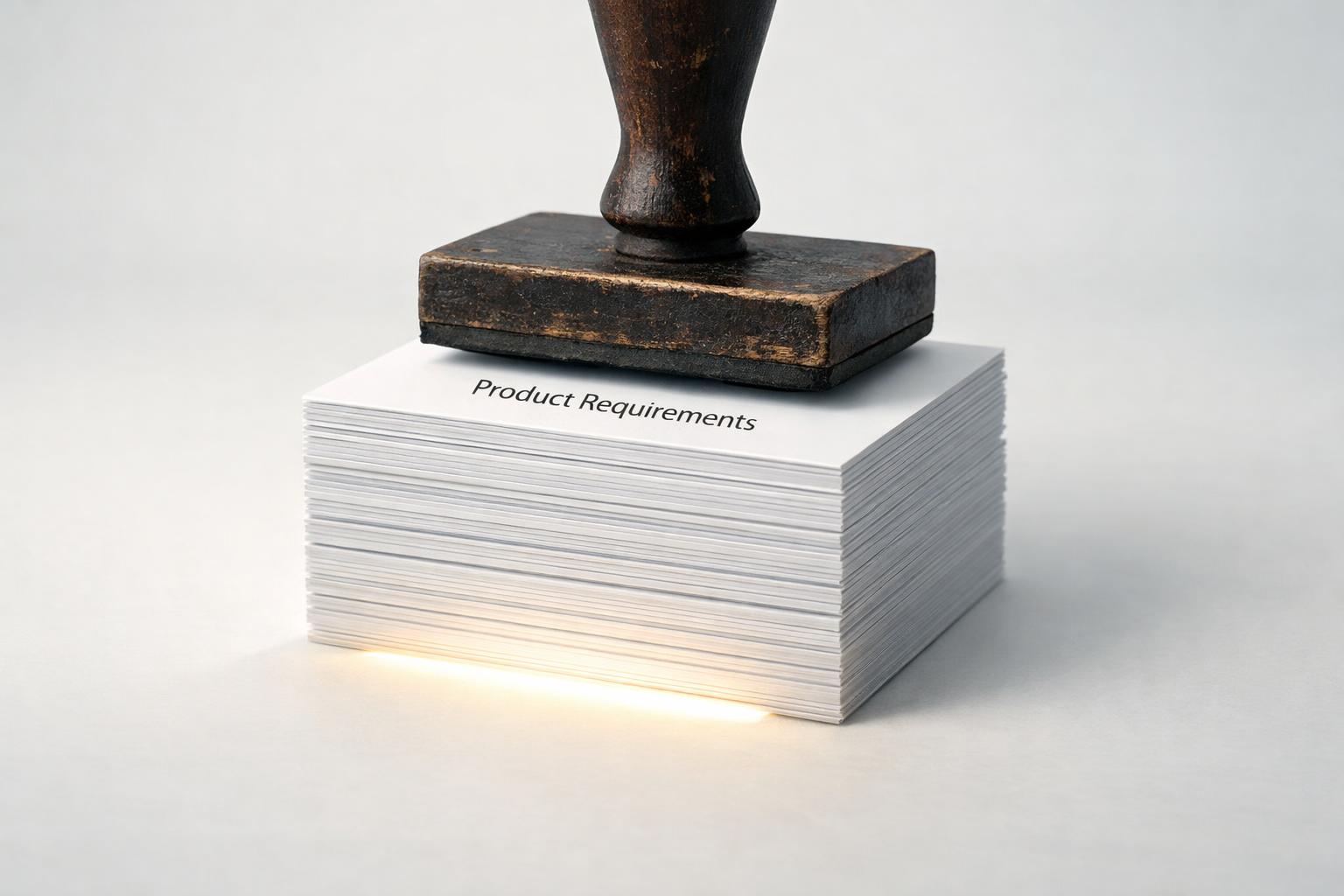
Repetitive work should shape which tasks to automate first, but the best candidates are the ones that are frequent, rule-based enough to standardise, and tied to a meaningful product outcome.
Quick answer: Repetitive work should heavily shape automation priorities in product teams, but not in the simplistic “most repetitive task wins” way. The right priority is repetitive work that is frequent, rule-based enough to standardise, painful enough to distract skilled people, and connected to a meaningful product outcome. Teams get the best results when they break work into specific tasks rather than trying to automate whole roles, then rank candidates by volume, variability, risk, and payoff. The catch: AI often changes work rather than simply removing it, so the real question is not “what can we automate?” but “what repetitive work should we redesign, automate, and measure so the team gets faster without just becoming busier?”
TL;DR
- Prioritise repetitive tasks, not repetitive jobs; task-level analysis produces safer and more useful automation choices.
- The best candidates are high-frequency, low-judgement tasks with clear inputs, predictable outputs, and visible business impact.
- Product teams should score automation opportunities by effort saved, quality risk, exception rate, and whether the task sits on a critical workflow.
- Expect AI to intensify work if you do not change team norms, scope, and measurement alongside automation.
Why repetitive work matters in the first place
Product teams are full of repetition, even when the work looks “creative” from the outside. The same backlog grooming steps repeat every sprint. Research notes are reformatted into decks. Jira tickets are rewritten for different audiences. Release notes are assembled from scattered updates. Customer feedback gets tagged, summarised, and re-summarised. None of that is glamorous, but it consumes attention from product managers, designers, analysts, and engineers (AI-powered success—with more than 1,000 stories of customer transformation and innovation | The Microsoft Cloud Blog).
That matters because repetitive work creates one of the clearest entry points for automation. Workflow automation tools are generally meant to reduce manual, tedious process steps, lower error rates, and improve speed (How to Break Down Work into Tasks That Can Be Automated). In product teams, this usually means removing admin drag around planning, reporting, handoffs, and documentation rather than automating core judgement calls such as product strategy or roadmap trade-offs.
But repetition alone is not enough. Some repetitive work is still high-stakes, context-heavy, or politically sensitive. A recurring pricing decision is repetitive in cadence, but not a good candidate for full automation. By contrast, translating customer interview transcripts into standardised insight templates is repetitive and often easier to partially automate.
The practical takeaway is simple: repetitive work is valuable as a signal, not as a decision rule. It tells you where to look first. It does not tell you what to automate blindly. Product teams should treat repetition as the start of prioritisation, then test whether the work is structured enough, frequent enough, and important enough to justify automation.
Which repetitive tasks should product teams prioritise first
The strongest automation candidates usually share four traits:
- They happen often.
- They follow a recognisable pattern.
- They consume skilled time without requiring much original judgement.
- They sit inside a workflow the team already cares about.
This is why task breakdown matters. Organisations often underperform with automation when they try to automate an entire job instead of deconstructing that job into tasks (Measuring Data Science Automation: A Survey of Evaluation Tools for AI Assistants and Agents). A product manager role cannot be automated. But parts of the work absolutely can: first-pass PRD drafting, meeting summaries, ticket hygiene checks, competitor update formatting, or weekly KPI snapshot preparation.
A useful way to think about this is to separate repetitive product work into three buckets:
- Administrative repetition: status updates, formatting, tagging, routing, scheduling, follow-ups.
- Analytical repetition: clustering feedback, summarising experiments, standard reporting, anomaly flagging.
- Communication repetition: drafting release notes, support macros, stakeholder updates, and handoff documents.
The first bucket is usually the easiest win. The second can create larger leverage but needs more validation. The third often looks attractive because generative AI handles language fluently, but it still needs review because tone, factual accuracy, and audience fit can drift (Real-world gen AI use cases from the world's leading organizations | Google Cloud Blog).
Good first priorities for many SMEs include: - Turning meeting notes into structured action logs, - Summarising customer feedback into consistent themes, - Generating first drafts of internal product documentation, - Automating workflow routing between tools, - Creating standard weekly product reporting packs.
These are repetitive enough to matter and narrow enough to test quickly. They also create visible relief for busy teams without touching the most fragile product decisions first.
Why the “time saved” view is too narrow
A common mistake is to rank repetitive work only by hours saved. That is too simplistic for product teams.
First, repetitive work often sits in bottlenecks. A 20-minute task that blocks engineering, design, or stakeholder decisions may be more valuable to automate than a 90-minute task done in isolation. Second, automation can improve consistency, traceability, and auditability, not just speed. Automated systems can capture activity and workflow data in ways that make bottlenecks and compliance gaps easier to see.
Third, AI-based automation may not actually reduce total workload. Research suggests AI tools often intensify work by increasing pace, widening task scope, and extending working hours (AI Doesn’t Reduce Work—It Intensifies It). In product teams, that can show up as “great, now we can produce twice as many specs, summaries, or experiments,” which creates more downstream review, more stakeholder expectations, and more decision fatigue.
So the better question is not “how many hours does this save?” It is:
- Does this reduce a real bottleneck?
- Does this reduce error or inconsistency?
- Does this free skilled people for work that only they can do?
- Does this create more work somewhere else?
- Does this change stakeholder expectations in an unhealthy way?
For example, automating customer-feedback summarisation can save time and improve pattern detection, but it may also lead teams to process far more input than they can realistically act on (AI-powered success—with more than 1,000 stories of customer transformation and innovation | The Microsoft Cloud Blog). Similarly, faster document drafting can create pressure to produce more artefacts rather than better decisions.
That is why healthy automation prioritisation includes operating rules. If a tool speeds up output, decide what will not expand as a result: number of reports, review cycles, meeting load, or after-hours responses. Otherwise repetitive work disappears in one place and reappears somewhere else in a more demanding form.
How to prioritise repetitive work in a product team
A lightweight scoring model works better than intuition. You do not need a huge transformation programme to start. You do need a shared way to compare automation candidates.
Score each repetitive task on five dimensions:
- Frequency – How often does it happen?
- Standardisation – Are the inputs, steps, and outputs reasonably consistent?
- Human judgement required – Can the task be reviewed rather than authored from scratch?
- Business impact – Does improving this task affect delivery speed, product quality, customer insight, or team capacity?
- Risk and exceptions – What happens when the automation gets it wrong?
A simple example:
| Task | Frequency | Standardisation | Human judgement | Impact | Risk | Priority |
|---|---|---|---|---|---|---|
| Sprint meeting summaries | High | High | Low | Medium | Low | High |
| Customer feedback clustering | High | Medium | Medium | High | Medium | High |
| Roadmap prioritisation | Medium | Low | High | High | High | Low |
| Weekly KPI reporting | High | High | Medium | Medium | Low | High |
| Writing final launch comms | Medium | Medium | Medium | Medium | Medium | Medium |
This is not scientific precision; it is a better conversation. It stops teams from chasing shiny demos and keeps attention on workflows that matter.
A structured approach to task automation usually starts with auditing workflows, identifying candidates with clear criteria, piloting, measuring, and then scaling. That sequence is especially important for product teams because many tasks span functions. A PM’s repetitive work is often coupled to engineering, support, sales, or operations. If you automate one local task while ignoring the full workflow, you can create friction instead of removing it.
One more practical rule: prioritise tasks where a human can approve the output quickly. This makes adoption easier. Teams trust automation more when it starts as assisted work rather than hidden black-box action (AI for Auto-Research: Roadmap & User Guide).
30-minute repetitive-work audit template
If you want to move from theory to a shortlist this week, run a 30-minute audit with one product lead, one hands-on PM or product ops owner, and one engineering or systems counterpart. For a small team, that may be 2 people; for a more mature team, include design ops, research ops, or RevOps if their tools are part of the workflow.
Minutes 0–10: list tasks. Each person writes 5–10 repetitive tasks from the last two weeks. Capture owner, approximate frequency, minutes per occurrence, systems used, and whether the task is politically sensitive. “Politically sensitive” means the task touches status, visibility, or decision rights, so even a good automation may need explicit stakeholder sign-off before a pilot.
Minutes 10–20: score each task 1–5 for frequency, standardisation, business impact, and risk; mark judgement as Low / Medium / High. - Pilot now: total score 14+ with Low/Medium judgement and Low/Medium risk - Investigate: 10–13, or strong impact with unclear workflow/tool fit - Do not start here: under 10, High judgement, or politically sensitive without sponsor approval
Minutes 20–30: choose one pilot and assign: - Owner: usually product ops, a PM, or an AI champion - Reviewer: the person accountable for output quality - Tool selector: engineering manager, ops lead, or security-aware admin
For the business case, use a simple formula: monthly hours saved = frequency × minutes saved per run × volume; then add bottleneck reduction, error reduction, or cycle-time improvement if relevant. Track 3 pilot metrics for 2–4 weeks: time per task, review pass rate, and downstream workflow impact (for example, fewer handoff delays or fewer missing fields). If you are choosing between tools, prefer the option that fits current systems, permissions, and review controls over the one with the flashiest demo.
Where AI changes the priority order
Traditional automation and AI-assisted automation are not the same thing. Standard workflow automation is strongest where rules are stable: move this ticket, notify this owner, create this record, update this status. AI becomes interesting when the repetitive work includes messy language, classification, summarisation, drafting, or multi-step analysis.
That creates a temptation to jump immediately to the most intellectually interesting tasks. Product teams should resist that. Current AI assistants and agents can support multistep workflows across research and analysis domains, but evaluation remains a serious issue and performance varies by task design, tool affordances, and real-world complexity. In plain English: demos are easy; dependable production use is harder.
So AI should change your priority order in two ways.
First, it expands the automation surface area. Tasks that were previously “too fuzzy” can now be partially automated: research synthesis, first-draft user stories, support-theme extraction, or proposal writing. Real-world enterprise case studies often report time savings on repetitive drafting and collaboration tasks.
Second, it raises the bar for governance. If a repetitive task produces content, recommendations, or classifications that influence product decisions, you need review rules, prompt standards, ownership, and some way to evaluate output quality over time. Otherwise product teams confuse plausible output with reliable output.
In practice, that means the best AI priorities are usually repetitive tasks where: - Output can be checked against source material, - Errors are reversible, - Quality can be sampled, - And the team can define “good enough” clearly.
Examples include: - Drafting first-pass PRDs from structured notes, - Summarising user interviews into standard templates, - Triaging incoming feature requests, - Producing draft release notes from merged tickets, - Generating experiment summaries from standard data inputs.
Examples that should come later include: - Autonomous roadmap recommendations, - Unsupervised customer-priority decisions, - Or agentic workflows that trigger external customer-facing actions without review.
For SMEs, the aim is not maximal automation. It is dependable internal capability. Repetitive work should point you to practical pilot opportunities that build trust, evidence, and team habits.
Bottom line
Repetitive work should influence automation priorities because it reveals where product teams are wasting skilled attention. But the right target is not “anything repetitive.” It is repetitive work that is frequent, structured, reviewable, and connected to a real team bottleneck or outcome. Start at task level, not role level. Pilot small, measure honestly, and watch for work intensification as much as time savings. If your product team is overwhelmed by scattered AI experiments, a disciplined repetitive-work audit is one of the fastest ways to turn automation from curiosity into a practical operating advantage.
Use tasks to automate that are frequent, structured, reviewable, and tied to a real bottleneck so pilots build trust without drifting into risky autonomy.